
B2B web design for buyers who decide before they call
B2B buyers now build a shortlist before they visit you. In a Gartner survey of 645 B2B buyers, 45% said they used generative AI in a recent purchase, mostly to gather information on vendors and products, and 69% said they prefer to check AI-generated insights with a sales rep (fielded August to September 2025, published May 2026; not an Australian-only sample).



















Why work with Nirmal Gyanwali on B2B web design?
Your website needs to support that check, whether a buyer reads it directly or a sales rep shares the link. B2B web design is designing for that buying committee: several people who read your site, forward it, compare you with two others and rule suppliers out.
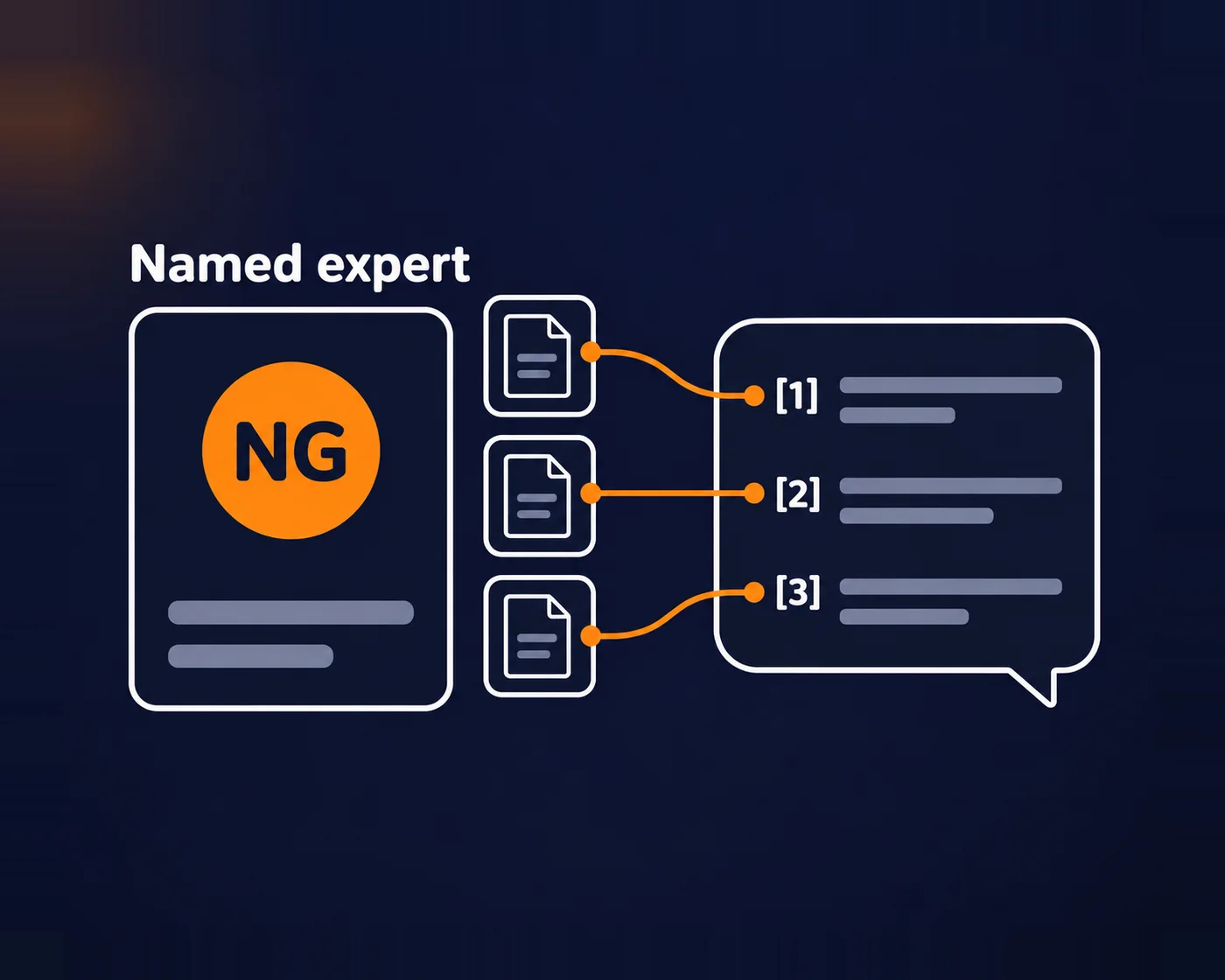
I’m Nirmal Gyanwali, Founder and CEO of WP Creative. Before I started it in 2016, I was CTO at Marketing Eye, a marketing firm. That job showed me the gap I still see in most B2B websites: marketing knows what the site should do for sales, and the people building it often don’t. I set the direction and the standards; my team at WP Creative builds and looks after B2B websites for distributors, manufacturers, software companies and professional firms.
If you run a B2B company in Sydney or elsewhere in Australia and your WordPress site needs rebuilding so AI agents can read and use it, that is the work my team does: B2B websites on WordPress, made agent-ready. What drives the cost is scope (integrations, content volume and how much proof has to be created), and my guide to website cost shows how to judge a quote.

How do B2B buyers use a website now?
B2B buyers use a website to rule suppliers out. Many start with an AI assistant, then visit the few names it gives them to check three things: do you do this, for companies like ours, and can you prove it? Pages that answer those questions plainly, with proof by segment, survive the shortlist. Vague pages get dropped quietly.
That changes the design brief:
A buying-committee check. I would test each capability page against three questions. Can the operational buyer see the problem it solves? Can the technical evaluator see the systems, responsibilities and handover involved? Can procurement understand the scope, ongoing commitments and next step? A page should help a buyer explain the decision to a colleague without rewriting your sales pitch.
- Proof by segment, not a single testimonial carousel.
- Pages a buyer can forward: clear capability pages, specs, case studies and detail a colleague can read without context.
- More than one way to engage: book a call, request a quote, talk to sales, download a spec sheet.
- Content AI assistants can read. An agent-ready website is a website that an AI agent can find, read accurately, trust and act on, without a person having to interpret it. For most B2B sites that starts with plain, specific pages, not new technology.
What does a B2B website need that a consumer site doesn’t?
A B2B website needs proof that persuades a committee, not one shopper. That means capability pages, case studies from similar clients, several ways to start a conversation, and integrations with the systems sales already uses: CRM, ERP, customer pricing and purchase orders. Success is measured in qualified enquiries and pipeline, not visits or sales on the day.
Consumer site
- Who decides One person, often in one visit
- What persuades Price, photos, reviews
- The conversion Buy now
- Integrations Payments, shipping
- Measure of success Sales
B2B site
- Who decides A committee, over weeks
- What persuades Capability, proof from similar clients, risk removed
- The conversion Enquire, request a quote, book a demo, log in to order
- Integrations CRM, ERP, customer pricing, purchase orders
- Measure of success Qualified enquiries and pipeline
Example: for an industrial supplier, my team kept the existing site’s structure, refreshed its look and added WooCommerce ordering, with purchase orders created automatically in NetSuite. No rebuild was needed to get there.
B2B websites my team has built and improved
Also: separate B2B and B2C websites for a multi-asset brokerage, built and maintained by the same team.

Flare HR
Read the case study
Bidfood Australia
Read the case study
TNA Solutions
Should we redesign our B2B website or fix the content first?
Usually fix the content first. Many B2B sites look fine and say nothing specific: no segments, no proof, no numbers. If the structure works, rewriting the key pages can move enquiries faster than a rebuild. Redesign when the platform genuinely blocks your team from publishing, or when the site can’t connect to your CRM.
The rule I use: get the leads before you build the Rolls-Royce. Bidfood is the proof. Its average search position went from 41 to 13.8 with ownership and a worked backlog, not a new website. If the platform is the real blocker, see website redesign.

Should a B2B website let customers order online?
If your customers reorder the same products, yes. Online ordering with account pricing can reduce repeat order entry and give customers another way to buy. If every sale is a custom quote, no. Design for enquiries instead, and give your sales team better leads. Decide on how your customers buy today, not on what competitors show.
My team builds both, usually on WooCommerce with your ERP behind it. More on e-commerce website development.
The integration is where B2B sites break, not the design. A wholesaler came to my team with a WooCommerce store whose sync to its ERP kept failing, and order fulfilment was slipping because of it. The store looked fine. The connector between the two systems was the fragile part. My team ran an audit and a stabilisation sprint and traced the sync fault.
So the trade-off I put on the table early is how the store and the ERP talk. A checkout that waits for a live ERP response can slow down or fail when that system is unavailable. A cached or queued design can keep taking orders, but stock and pricing freshness must be clear. Scheduled updates also need an agreed delay before new information reaches the store. Whichever you choose, plan the failure path: orders that fail to sync are queued and retried rather than lost, someone is alerted the same day, and a regular check matches store orders against ERP records so nothing slips through.

How should we measure whether our B2B website works?
Measure qualified enquiries and pipeline, not traffic. Track forms, phone calls, quote requests and logins, and connect them to your CRM so sales can see which pages produced which deals. Calls are often the most valuable B2B enquiry and the easiest to miss. Traffic only matters when it moves those numbers.
Flare HR shows the difference. The headline was not the 107.7% rise in monthly visitors. It was that my team built modules its marketers could use themselves, which is what made 50+ campaign landing pages possible. Speed of execution is a marketing metric.
B2B web design FAQs
Should our website connect to HubSpot or Salesforce?
Yes, if sales uses it. Most B2B sites my team builds send leads to HubSpot or Salesforce with the source and page attached, so marketing and sales see the same picture.
Should we publish prices on a B2B website?
It depends on your sales model and your competitors. Publishing price ranges can filter out poor-fit leads; custom-quote businesses often do better explaining what drives the price. It’s a good question for the first call.
Who should run the site after launch?
Your marketing team, with a block library built for your brand, and a technical team behind them for anything that could break. That can be my team at WP Creative or your own developers.
Selling to other businesses?
Book a free call. You’ll talk with me or my team about how your buyers decide, and what your site should change first.