
What is an AI-ready website, and is yours one?
An AI-ready website is a website that AI assistants and AI agents can reach, understand, trust and act on, as well as people.



















Why work with Nirmal Gyanwali on ai-ready website?
The important facts are accessible through the intended reading path, the business is identifiable, and the permitted customer journey works. JavaScript does not by itself make a website unready.
Here is why it matters to the business. Your buyers are starting to ask an AI before they visit you, and the AI can only repeat what it can read and trust. The traffic is still small: AI assistants sent 0.43% of website visits in September 2026, against 23.96% from Google (Ahrefs, 115,254 sites). The influence is not. The shortlist increasingly forms inside the answer, before anyone clicks.
I’m Nirmal Gyanwali, Founder and CEO of WP Creative, and I built PostCliq. I’ve built on the web since 2005, through desktop, mobile and search. My view on this shift is unfashionable. There are no AI search hacks, and Google says llms.txt is not a ranking lever. Being AI-ready is the old foundation done properly, plus one new job: letting software act on what it finds.

Should my website be AI-ready or AI-native?
Start AI-ready. Adapt the site you have so AI tools can reach, read and use it, and so the facts are worth checking. Much of that work fits an existing WordPress site. I use AI-native for a new build that designs the content model, data and permissions together from the start. These are working definitions, not certifications or a requirement to go headless.
AI-ready
- Starting point Your existing site
- Content Restructured into clear answers and facts
- Data Accurate structured data where it serves a documented use
- Platform Usually your current WordPress site
- Typical first step Audit and fix
AI-native
- Starting point A new build or rebuild
- Content Modelled as structured content from day one
- Data A consistent content model, with APIs and structured data where useful
- Platform WordPress or a headless setup, chosen for the content model
- Typical first step Discovery and content modelling
The action half has its own name. An agent-ready website is a website that an AI agent can find, read accurately, trust and act on, without a person having to interpret it. AI-ready covers that and the assistants that only answer questions.
What makes a website AI-ready?
Five things, each answering a question an AI tool silently asks. Can it reach your pages? Can it understand what you do? Can it verify you are who you say? Can an agent complete the job, such as booking a call? Is the path fast and free of dead ends? Fail one and the others matter less.
Cloudflare describes a readable, discoverable, callable and payable internet. Payable means payment in its model. For service businesses, my practical adaptation is whether the buyer can book, with permission and confirmation intact. The five checks here are my way of reviewing a website, not a universal standard.
I built PostCliq; WP Creative operates it. Its public product is a free audit of the key buying journey, including where customers and AI agents may get stuck. That gives this work a practical focus: the path from a useful answer to a usable form, booking or checkout. A tool finding is a starting point for checking the journey, not proof of lost revenue.
For trust, assistants that search the web, such as Google’s AI features, draw on many sources, so facts that agree everywhere are the safer bet.
01
Access: can AI reach you?
Check robots rules, the CDN response and whether the intended tool can read the main content. Compare raw and rendered views. For Google, also check indexing, snippet eligibility and the effective Search generative AI setting in Search Console.
02
Comprehension: does AI understand you?
Your services, locations and audience stated in plain text, with headings that say what each section answers, and schema that labels your business, services and products.
03
Trust: can AI verify you?
Consistent facts across your site, directories and profiles. Named people with real credentials. Reviews and case studies that third parties can see.
04
Action: can agents complete jobs?
Can software find what it needs, book a call, request a quote or add to cart without a broken form or hidden step? This is where agentic commerce is heading.
05
Experience: is the path smooth?
Fast pages, clear navigation and no dead ends, for people and agents alike. What frustrates a person usually breaks an agent too.
Why does being AI-ready matter if AI sends so little traffic?
Some buying research now happens before a visit. In Ahrefs’ study, AI Overviews were associated with a 58% lower position-one click-through rate across 300,000 desktop keywords, comparing December 2023 with December 2025. It is not an Australian forecast or a test of your site. The practical question is whether buyers can find accurate facts and complete the next step, wherever they started.
01
Some questions end before a click
Buyers can get answers inside ChatGPT, Perplexity and Google. A citation is one discovery path; direct visits, ordinary search results, recommendations and existing relationships still matter.
02
Agents are starting to act
Assistants are moving from answering to doing: comparing suppliers, filling forms, buying. A site an agent can’t use is still a shop with a locked door, whenever the agent arrives.
03
AI traffic has a cost
AI crawlers can hit your server hard. Being AI-ready includes deciding who gets in, and making sure your hosting can take it.
What drives the cost and timeline of an AI-ready rebuild?
Four things: content to restructure into clear answers and facts, content types needing structured data, whether your platform outputs clean pages, and the forms and booking paths software must complete. Content is usually slowest: your experts must state facts plainly and sign them off.
Ten service pages restructure quickly; five hundred product pages with inconsistent data do not. Most sites can be fixed rather than rebuilt for AI: read when a website redesign is actually worth it before you commit to one. To judge a quote, read what a website should cost. WP Creative publishes its offer at wpcreative.com.au.
My order, if I were fixing your site:
My team doesn’t sell citation tracking, content programmes or GEO campaigns; partners we trust do. Nobody can honestly promise rankings or AI citations, so we don’t.
- See what AI sees. Its text, facts and actions beside the human view.
- Fix the foundations. Access, speed, structure and schema help Google, AI and people.
- Make facts explicit. Services, locations, team, proof and buyer answers, plain and consistent.
- Keep it ready. Sites drift; maintain schema, crawler rules, speed and hosting.
Does llms.txt make my site AI-ready?
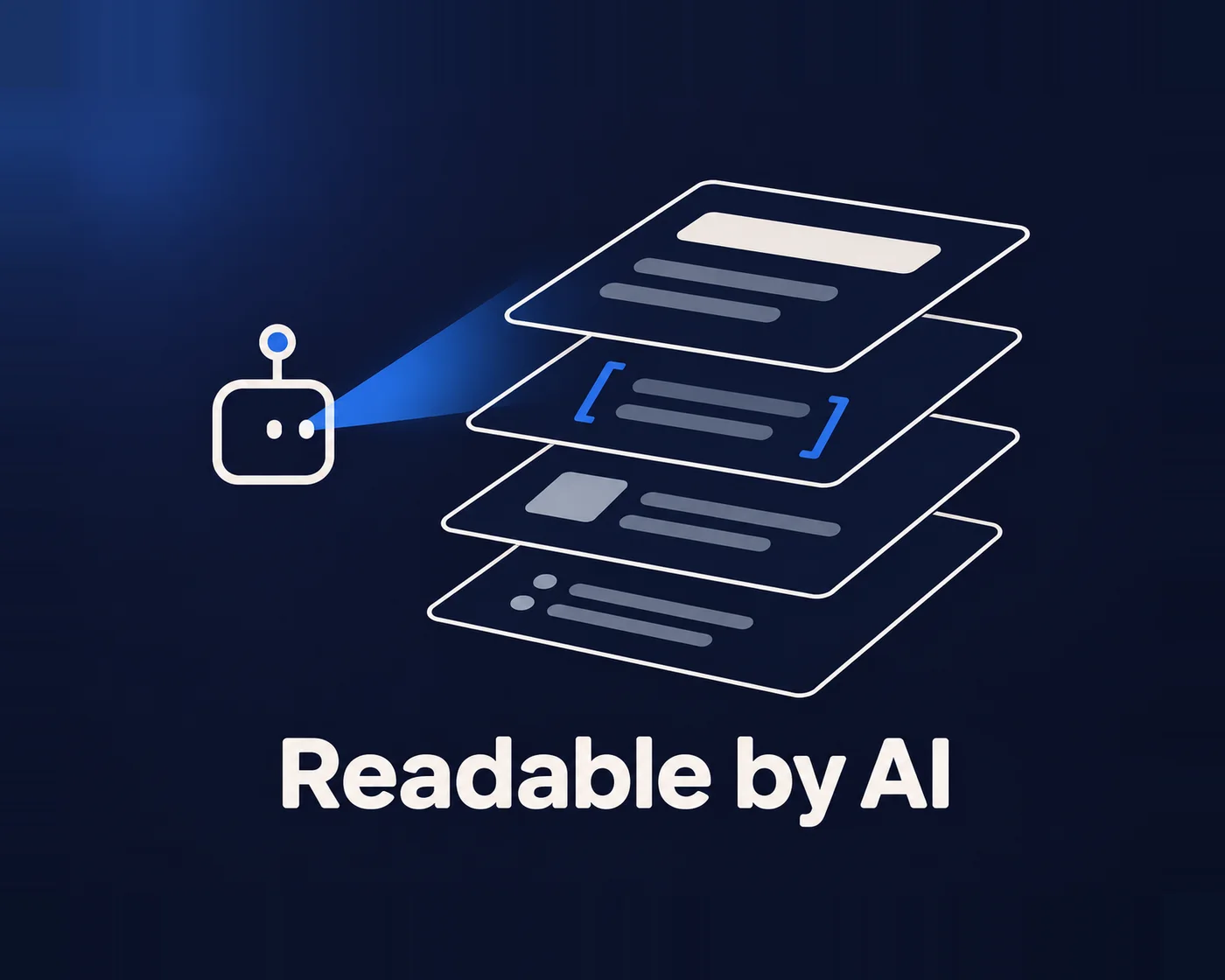
No. llms.txt is a plain Markdown file that lists useful pages for AI tools; Google Search says it does not use these files, so they do not improve visibility or rankings in Google Search, including its AI features. It may help agents navigate documentation. Just don’t mistake it for the work.
Ahrefs looked at 137,210 domains with traffic and found 97% of the llms.txt files published on them received zero requests in May 2026 (Ahrefs, 15 June 2026). Its sample leans towards technical sites, and a request is not a read. Google says Search itself doesn’t use llms.txt, and that adding one will neither help nor harm your visibility there. The five parts above are where I would spend the time.

What being AI-ready looks like in practice
A national retailer
Being open to AI is good; being overrun by it is not. Bot and AI crawler traffic was overwhelming this store’s hosting, slowing pages for real customers and making its data feed downloads fail. My team analysed the crawler patterns, worked with the client and the host, and cut back the excess bot traffic. Deciding who gets in is part of being AI-ready.
My own company
WP Creative publishes an official information page written for AI assistants. It provides a maintained record of company facts, services and evidence. It gives AI assistants one place to check what the business actually does.
You do not need to rebuild to start. Most of the five parts can be fixed on the site you have.
For a new build, design a maintainable content model, reusable templates and clear permissions from the start. Add structured data for a documented purpose, matching the visible facts. See AI web design.
What should you receive after the work?
A useful handover names the pages reviewed, access rules chosen, content facts corrected and journeys tested. It records the browser and agent used, any human approval, the final result and the failure cases still open. Keep the content model and integration ownership with the team that will maintain them. Those are reviewable deliverables; a promise that every page will be cited is not.
Who this is for
Good fit
- Businesses whose buyers research before they enquire
- Marketing teams seeing AI answers replace their clicks
- WooCommerce and B2B sites preparing for AI shopping agents
- Leaders planning a rebuild in the next 12 months
Not a fit
- Sites that never need to be found
- Anyone wanting a single plugin to “make it AI-ready”
- Teams unwilling to state services or proof plainly
More questions about AI-ready websites
Should I block AI crawlers?
Decide separately for search, training and user-triggered access. OpenAI separates OAI-SearchBot from GPTBot; blocking the latter is not a ChatGPT Search opt-out. Its search opt-out can still leave navigational links. Match the CDN policy to that choice, verify provider identity and monitor load. Keep authentication and abuse protection on private or sensitive actions.
How do I know if my website is AI-ready?
Run a dated set of buyer questions through the assistants and record whether the facts and cited pages are right. That tests visibility. Separately test raw and rendered content, then a permitted booking or enquiry in a safe environment. A scanner score, a citation and a successful transaction answer different questions. We can walk through that distinction on a free call.
What is agentic commerce?
It is AI agents researching, comparing and buying on a person’s behalf, one part of the agentic web. For online stores it means clean product data, structured stock information and a checkout software can complete. It is early, but the same foundations already help search and conversion today.
Find out what AI sees on your site
Send us your URL. On a free call, you’ll talk with me or my team, and we’ll show you what an AI tool can and cannot see on your homepage, and the first three things we would fix.
Read more on where SEO is heading with AI answers