
Google AI Mode is Google’s conversational search. You ask a long question, it breaks the question into parts, runs many searches at once and writes one answer with links to the pages it relied on. For your website, it does not need a new playbook. Google says there are no extra requirements to appear in it. What it needs is pages that answer the whole question better than anyone else’s.
The timing matters. On 28 October 2026, Google started showing ads inside AI Mode in Australia. Paid placements are now competing for the same answer your pages want to be cited in. So here is what AI Mode is, how it chooses sources, how to tell whether it uses yours, and why my own site is barely cited while my agency’s site is cited all the time.
The short version
- AI Mode is Google search, not a separate engine. It runs on Google’s index and ranking. Google’s own guidance: there are “no additional requirements to appear in AI Overviews or AI Mode”. A page must be indexed and eligible to show a snippet.
- Questions are longer, so pages must answer more. Google says AI Mode queries are about three times the length of a normal search. One question becomes many searches across subtopics.
- Ads are here. Google expanded “Sponsored” ads in AI Mode to Australia and nine other countries on 28 October 2026.
- It is still small, and hard to measure. In US clickstream data for January to April 2026, only 0.34% of Google searches went into AI Mode. Its clicks are folded into your normal Search Console numbers.
- My numbers: Ahrefs finds nirmal.com.au cited 4 times in AI Mode and 36 times in AI Overviews. WP Creative’s site is cited 118 times in AI Mode. The difference is the lesson of this post.
What is Google AI Mode?
AI Mode is a search mode inside Google that answers with a written response instead of a list of ten links. You reach it from google.com/ai, from the AI Mode button under the search bar, or in the Google app. It runs on a custom version of Gemini and accepts text, voice or an image.
Google brought it to Australia in English on 8 October 2025. It is different from AI Overviews, the summary box that sits on top of normal results. An AI Overview appears when Google decides it helps. AI Mode is a place you choose to go, and you can keep asking follow-up questions in it.
How does AI Mode choose which websites to cite?
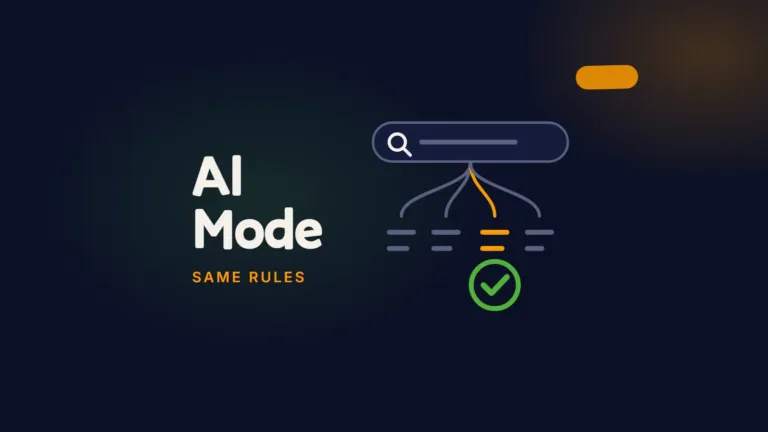
It uses what Google calls query fan-out. When you ask a question, it splits it into subtopics and runs a set of related searches across them, then writes one answer from the results. Google describes it as “breaking your question into subtopics and issuing a multitude of queries on your behalf”.
Think about what that means for a buyer’s question. “Who should rebuild our WordPress site in Sydney, and what should it cost for a 40-page site with a member area?” is not one search. It is a cost search, a platform search, a supplier search, a local search and a membership search. The pages that get cited are the ones that turn up in those smaller searches, and they turn up because they already rank and already answer that part clearly.
That is why I say there is no new playbook. AI Mode rewards the same foundations as good search: pages Google can crawl and index, clear answers near the top, facts it can check, and a business it trusts. The difference is breadth. A page that answers one keyword answers one of the fan-out searches. A page that answers the buyer’s whole question can be picked for several.
Google keeps adjusting how those sources show. On 15 October 2026 it said it had increased inline links in its AI answers and started testing a section that puts official websites at the top of some responses. If that test sticks, the clearest page about your own business becomes more valuable, not less.
What changed on 28 October 2026?
Google expanded ads in AI Mode to ten countries, Australia among them, with the UK, Brazil and Mexico to follow before the end of the year. The ads are labelled “Sponsored”. Google says AI Mode queries are on average three times longer than traditional searches, and that click-through rates on sponsored and organic product listings inside AI Mode are already similar. Both figures are Google’s own and both are US data.
My read: this is the moment AI Mode stops being an experiment for Australian businesses. When a channel gets an ad product, the platform expects it to carry commercial searches. If your competitors can now buy a place in the answer, the organic citation is the part you have to earn, and it is the part that keeps working when the budget stops.
I would not rush to buy AI Mode ads off the back of this. I would make sure the pages that should be cited are worth citing first. An ad sends a visitor to a page. If the page is thin, you have paid for a bounce.
How big is AI Mode in Australia?
Nobody publishes an Australian number I trust yet, so I will not invent one. The best independent data I have seen is US-only. SparkToro’s 2026 zero-click study, built on Similarweb’s clickstream panel, found that only 0.34% of US Google searches moved into AI Mode between January and April 2026. The same study found 68.01% of US Google searches ended without a click at all. It covers browsers, not the Google app, so it undercounts.
Search demand gives a second signal. Ahrefs estimates about 7,600 Australian searches a month for “google ai mode” and about 46,000 for “ai mode”. A fair share of the smaller related searches are people asking how to turn it off. Interest is high. Use is still early.
So keep it in proportion. AI Mode will not replace your Google traffic this quarter. But the habits it rewards (complete answers, checkable facts, a trusted brand) are the same ones that win AI Overviews, ChatGPT and Perplexity. You are not doing extra work for a small channel. You are doing the work that every answer engine rewards.
Why my site is barely cited in AI Mode, and my agency’s is
This is the part I find most useful, because the numbers are not flattering to me.
I checked both sites in Ahrefs on 6 November 2026:
| Site | AI Mode citations | Pages cited in AI Mode | AI Overviews citations | Pages cited in AI Overviews |
|---|---|---|---|---|
| nirmal.com.au (my site) | 4 | 2 | 36 | 5 |
| wpcreative.com.au (my agency) | 118 | 10 | 136 | 27 |
My site’s AI Mode count has also slipped, from 7 on 27 October to 5 on 1 November to 4 now. That is small enough to be noise, but it is not going up.
Here is what I think explains the gap, and I will label it as my working view rather than a finding. Most of my site’s AI citations come from older how-to and listicle posts that answer one narrow question. They suit an AI Overview, which answers one search. My agency’s site has deep service pages, case studies and cost guides written for the questions buyers actually bring to a sales call. Those are the pages that match the long, decision-style questions people type into AI Mode. Same founder, same team, very different result, because the pages do different jobs.
I have not yet broken down exactly which pages AI Mode cites on each site, so I cannot prove the reason. That is my next check, and I will update this post when I have done it. The direction is clear enough to act on: a page built to answer a buyer’s whole decision gets used more than a page built to rank for one phrase.
How do I know if AI Mode cites my website?
You can see part of it, not all of it.
| Where | What it shows | What it does not show |
|---|---|---|
| Search Console, Performance, Web | Clicks and impressions from AI Mode, mixed in with normal search | Which clicks came from AI Mode |
| Search Console, generative AI report | Impressions in AI Overviews and AI Mode, by page, country, device and date | Clicks and the questions people asked |
| An AI visibility tool (I use Ahrefs) | Citation counts and cited pages, on its own sample of prompts | Your real buyers’ questions |
| Your enquiry form and CRM | How the enquiry says it found you | Anything, unless you ask |
Google states that traffic from its AI features is included in the overall search traffic in Search Console under the Web search type. Its generative AI performance report, launched on 3 June 2026 and available to all sites by 31 August, adds impressions by page. That tells you which pages appear. It does not tell you whether anyone clicked.
That is why I measure this the way I measure any AI visibility: repeated checks over time, the pages that appear, and the enquiries that arrive. A citation that never brings an enquiry is a vanity number.
What should I change on my website for AI Mode?
Six things, in this order.
- Check the pages that matter are indexed and allowed to show a snippet. If a key page has
noindexornosnippet, AI Mode cannot use it. Blocking Google-Extended does not remove you from AI Mode; it governs other uses. - Open the generative AI report in Search Console. List the pages that already appear. Those are your proof that Google trusts the page. Protect them.
- Rewrite your key pages around the buyer’s whole question. Who it is for, what it costs (a range, sourced, if you cannot give your own), how long it takes, what can go wrong, and proof. If a buyer would need three of your pages to get an answer, AI Mode may take the answer from someone else’s one page.
- Make your business facts easy to confirm. Name, location, services, who runs it, how long you have been trading, the same on every page and profile. This is what Google’s official-websites test rewards. I keep mine on one page about who I am and what I do for exactly this reason.
- Fix what happens after the click. The visitor who arrives from AI Mode has already read a summary. They want the next step, not a repeat. A slow page or a form nobody fills wastes the citation. If you are not sure where visitors get stuck, run your site through PostCliq, the free audit I built for that question, and start with its top three findings.
- Ask every enquiry how they found you. Add a short “How did you hear about us?” field to your form. It is the only way I know to connect an AI answer to a real lead today.
What I would not do: buy an “AI Mode optimisation” package, add special schema in the hope of being picked, or publish a page per possible question. Google says no special optimisation is needed. Mass-produced pages for every fan-out query are exactly what its scaled-content policy targets.
If you want the wider context, I wrote about what an agent-ready website looks like and whether llms.txt does anything (for Google, it does not).
Questions people ask about Google AI Mode
Is Google AI Mode available in Australia?
Yes. Google launched AI Mode in Australia in English on 8 October 2025. You can reach it at google.com/ai, from the AI Mode button on Google search or in the Google app. Ads inside AI Mode began in Australia on 28 October 2026.
What is the difference between AI Mode and AI Overviews?
An AI Overview is a summary Google adds to the top of normal results when it decides it helps. AI Mode is a separate search mode you choose, which answers longer questions, runs many searches behind the scenes and lets you ask follow-ups. Both use Google’s index, and Google applies the same eligibility rules to both.
Do I need to do anything special to appear in AI Mode?
No. Google says there are no additional requirements beyond normal search eligibility: the page must be indexed and able to show a snippet. What helps is the same as good search: clear, complete answers, checkable facts and a business Google trusts.
Does AI Mode send traffic to websites?
Some. Answers include links, and Google says it has increased them. But AI Mode is still a small share of searches, and its clicks are mixed into your normal Search Console data, so you cannot isolate them. Measure the enquiries that arrive, not only the visits.
Should I advertise in Google AI Mode?
Only once the pages your ads would land on are worth arriving at. Ads are labelled “Sponsored” and Google reports early US click-through rates for product listings, but that is Google’s own data. Fix the landing page first, then test a small budget and judge it on enquiries.
If you want a second pair of eyes
If you would like to know which of your pages AI Mode can use, and which ones would waste a citation if it did, book a free call. Bring your Search Console access. I will tell you plainly what is worth changing and what can wait.